Friday, 17 May 2013

Talk no. 3: Information and Perception: Living Through a Revolution

Four talks on disaster risk reduction, no. 3
Information and Perception: Living Through a Revolution


We live, in the Information Age, or so it is said. According to the pyramidal diagram constructed by the eminent geographer Yi-Fu Tuan, information is the second of four levels of understanding. It renders the base of the pyramid, facts and observations, more powerful by combining them in such a way as to add value, but it lacks the insight and explanatory power of the higher levels, knowledge or wisdom. Hence, information is not wisdom: it constitutes the bricks from which we can, if we want to, build the wall of knowledge, from which, we might, if we are lucky, accede to the lofty heights of wisdom.


Professor Henry Quarantelli, the doyen of disaster sociologists, wrote that the current information and communications technology revolution is about as important for humanity as the invention of printing was in the fifteenth century. He noted its enormous power to transform the way we view the world and hence the way we react to disasters. However, he also listed a dozen unintended consequences that will need to be dealt with, and that may create problems rather than solve them.

We also live in an unstable age, one characterised by vast and profound changes. Many of their most important implications are currently unpredictable and are likely to remain so for a long time. We have glimpsed enormous potential, but do we know how to harness it? The copiousness and unprecedented ease of access that characterise modern information resources pose severe challenges. The first is how to appreciate and utilise such a huge amount of information. How to separate useful from useless information is a pressing problem. So is how to verify the truthfulness of information and interpret its meaning.

The greatest risk is posed by the fact that, when confronted by avalanches of facts and data, the easy way out is to treat them superficially. The bombardment of new information is a sort of solar wind that blows constantly through cyberspace and the mass media. In reaction, the world's attention span is limited and fickle, It passes rapidly from one novel incident to the next. As a result, we have developed an attitude to disasters that brings to mind the ice-cream parlour, home of the 'flavour of the month'. Today as I write, the flavour is 'earthquakes', as two very damaging ones have just occurred in northwest Iran. Perhaps next month it will be floods, or terrorism, or nuclear radiation releases. It all depends upon what happens in the meantime.

Long ago, risk researchers determined that people find it difficult to evaluate risks concurrently, and hence, despite the fact that we all run multiple risks all of the time, we tend to think about them sequentially, one or two at a time. Clearly, in the 'flavour of the month' approach, this is also true of the collective psyche of the mass of viewers, listeners, readers and surfers, the consumers of news (which we all are).

The survivors of the information age are those of us who know how to adapt to it. This not only means adapting the way we seek and assimilate information; something that is now radically different from how we did it half a century ago. It also means learning how to exploit the sources and flows of information and how to commandeer and dominate the interpretations. Verily, the soothsayers have not gone away. They no longer look at the tails of comets and tell us that the gods are angry, but there is no guarantee that a pundit with a strong presence on the dominant mass media will offer anything better, for we live in an age in which the public has developed a chronic appetite for personalities. Incidentally, the original pundits carried the equipment when the British surveyed north India. No doubt it was a repetitive job, because modern punditry certainly is.

One well-known pundit of the modern media was a certain Dr Iben Browning. His chosen field was one of the most contentious in science: the short-term prediction of earthquakes for the purposes of warning people of their imminent arrival. In 1990 he "predicted" (if that is the right word—which it probably isn't) an earthquake in southern Illinois. Modern media do not distinguish well between 'plausible' and 'specious'. Browning is now deceased: he took his earthquake prediction secrets to the grave with him. However, in 1990 he developed a strong and plausible mass media presence that put the official scientists to shame.

No earthquake occurred in southern Illinois during the period specified by Browning, but anxiety proliferated among the local population and there was a significant convergence reaction among the US mass media.

Short-term earthquake prediction may never be feasible. Although there are nine or ten physical phenomena that can undergo characteristic, or 'signature' changes hours or days before earthquakes, the level of uniqueness in slip-faulting mechanisms militates against developing a standardised short-term prediction measure that can be employed with ease around the world. And, incidentally, contrary to public perception, the anomalous behaviour of animals is about the least reliable earthquake precursor, such are the unknown vagaries of the psychology and reflexes of animals large and small. Nonetheless, all physical precursors are being actively, indeed intensively, studied by scientists in the hope that one day there will be a break-through.

The US Geological Survey, as custodian of America's scientific values in this field, examined its navel after the Browning affair and concluded that it had underestimated the power of charlatans to manipulate the media and appear credible. A publicity offensive should have been mounted on behalf of official science. Incidentally, Browning's coup de theatre was the fact that he managed to convince a legitimate geologist that his prediction had substance. The man in question was eventually sacked by his university for misconduct.

Two years later, in 1993, the US Geological Survey issued a prediction for a moderately powerful earthquake on a locked segment of the San Andreas fault in California. By virtue of having a surface expression, the San Andreas enjoys a public image that few other active faults can aspire to (most of them are deeply buried). The role of cowboy films and Easy Rider can perhaps be detected in the fact that equally spectacular surface faults in China and Venezuela remain unknown to the world's media audiences.

Parkfield, California, lies astride the locked segment of the fault. In 1993 it had a population of 57, plus 300 scientific instruments, 80 of which were continuously recording. Within days of the start of the USGS's 'Parkfield Earthquake Experiment', the local population had swollen to over 2,000, a motley combination of media representatives, New Agers and the curious and idle. But after 18 months the experiment ended without a significant seismic event—and even today it still hasn't occurred.

Official reports by the US Geological Survey make it clear that a 90 per cent probability of a magnitude six earthquake also means a perfectly respectable ten per cent probability of nothing at all. And that is what transpired. It reminds me that I once attended an earthquake conference at which the flower of Californian seismologists congregated in a flimsy looking room that projected outwards from the first floor of a monastery (a 1930s edifice, not something Mediaeval—this was California), about ten kilometres from the San Andreas fault. It was interesting, if somewhat macabre, to speculate what would have happened if the 'big one' had occurred while we were all in that room, but such thoughts took no account of the hard reality of probabilities. And if probabilities did not enter into my considerations, they are positively shunned by the general public.

It is an interesting exercise to type 'earthquake prediction' into an Internet search engine. Bona fide, official science has its websites, and these explain that long-term, regional earthquake prediction is effectively a solved problem with routine procedures, but short-term transient prediction is no more than an elusive goal. What is worrying, however, is that there are many other websites that confidently predict major earthquakes all over the place, and usually the day after tomorrow. Hence, the Internet has given free rein to the charlatans. Although the science behind their activities is false or suspect, the visual impact of their sites is usually as good as that of the USGS. And because it is the Internet the sites are not policed.

Many a legitimate scientist would like to be the one who is remembered for ever after as being the person who cracked the problem of how to predict an earthquake reliably in the short term. The fact that earthquakes do commonly emit precursors makes this goal seem tantalisingly near at hand. Fortunately, bona fide science has its in-built protection mechanisms which ensure that legitimate scientists do not make unjustifiable leaps of faith, and that charlatans are excluded from the circle of practitioners. But does the public realise this? The socio-economic implications of earthquake prediction are potentially enormous: house prices may dip, people may not go to work, children may be kept away from school, residents may leave the area, psychological pathologies may develop, and so on. In other words, the stakes are high in both the negative and the positive senses, for being able to predict imminent earthquakes could indeed save lives if it were coupled with a well-rehearsed plan of action.

In 2004 a talented Israeli sociologist, Avi Kirschenbaum, published a book about disasters. The body of his text reported a well-executed but fairly standard social survey of how the Israeli population reacts to threats, hazards and emergencies—a kosher piece of work. However, there was something radically different about his first and last chapters. In Chapter 1, Kirschenbaum plotted the number of disasters, worldwide, against the dates on which important disaster management organisations were founded. He discovered a significant correlation. Now, most researchers would automatically assume that the organisations, associations and agencies were founded in response to the disasters. In individual cases, that is often so. However, Kirschenbaum thought the opposite. He argued that there are increasing numbers of disasters because there are increasing numbers of disaster management agencies, not the other way around. His thesis was that these organisations have a vested interest in self aggrandizement and therefore tend to inflate the number of disasters and the magnitude of their impacts. In reality, he wrote, the increases in the size and frequency of disasters have been relatively modest.

Kirschenbaum's last chapter contained a radical proposition. Having argued that the world can ill afford such rampant inflation in the number of disaster management agencies, he suggested that the best thing to do would be to make disaster response a fee-for-service activity. If a person, or a family, does not subscribe to it, they will receive no help when the next disaster occurs. Since Kirschenbaum was writing in the early 1990s privatisation has become more and more fashionable and has been applied with careless abandon to many public services in many countries. Why not civil protection? Parts of it are already in private hands anyway, for example in branches of many countries' health services.

In my view there are too many considerations about welfare and the care of the vulnerable for such an approach to be morally justifiable. I will return to this issue in my next talk. But for the time being I would like to point out that Kirschenbaum's book should be required reading. It is a sort of "intellectual cod liver oil" for disaster specialists: it tastes bad but it does you good.

Is 'virtual reality' an oxymoron? And in any case, what is reality? An enduring image comes to my mind. It shows a village ruined by earthquake. All the houses are visibly damaged, and some have collapsed. They have been abandoned by their occupants, with one exception. This is the coffee bar at the centre of town, which has reopened with temporary connections to electricity and water supplies. Inside it there is a party of local residents who are grouped around a television screen. They are watching an image of a town that has been ruined by earthquake and abandoned by its inhabitants, except for one building at its centre. Possibly it is their own town.

This early and rather primitive example of a sort of virtual reality highlights the importance of perception of hazards, risks and disasters. Although perception studies have been conducted in this field for the past seventy or eighty years, they have only really come into their own since the 1970s. In part, this is an effect of the development in the 1970s of the concept of subjective risk (as opposed to measurable 'objective risk' based on hard data about probabilities). In the end, perception equals money, because it can be equated with what people are prepared to pay for safety and what services they are not prepared to underwrite because they perceive them as being unacceptably risky.

Disaster risk is a parallel world to the one we live in. I will go further: risk does not exist. I hasten to add that despite that it is no less real. But risk is like friction, it only comes into play when it is mobilised. We can never make a direct measurement of risk: what we measure in its stead is impact, and by then the risk is over and done with.

Under these circumstances it is not surprising that risk has proved such an elusive phenomenon, easily misunderstood, seldom perceived accurately (if accuracy is possible) and in many cases feared and dreaded.

Our parallel world is not merely inhabited by risk, it is increasingly subject to risk aversion. A risk is regarded as 'dreaded' if it is considered intolerable. What is tolerable is a matter treated with great elasticity. I mentioned in a previous talk that the glare of publicity can turn on the flow of solidarity; and turning off the stream of reporting can stifle the process of donation. Likewise, the degree to which a risk is feared or dreaded—conversely, the extent to which it is accepted—depends at least in some measure on publicity.

In the mid-1960s in a classic article in Science magazine, the risk analyst Chauncey Starr declared that "a thing is safe if its risks are judged to be acceptable". Hence, safety is a variable factor, indeed, one that varies over time. This means that it is also malleable. In that sense, the mass media are the mirror of what society is thinking and of its sense of values. But it is a two-way relationship, in many ways, more or less subtle, the media can create society's agenda. It can very easily pander to people's prejudices.

One evening I turned on the television news and the top story was a train crash which had occurred that afternoon at a place called Crevalcuore (which translates into English rather aptly as "break-heart"). Nineteen people died when two trains crashed head-on in fog on a single-track line. News is, of course, not merely a question of reporting the facts, but also involves putting a spin upon them, emphasising a particular angle, and selectively reporting the details. Evidently in this case the television news editors had a grudge against the state railways. The news bulletin gave the distinct impression that it would be far safer to get on the motorway and drive like a maniac in thick fog than set foot in a train. Trains are actually a very safe means of transport in Europe, yet on a previous occasion the same news service had reported the deaths of six passengers in a crash as a "massacre", while the deaths of six times as many people in road accidents during the same weekend was treated as a "normal", unexceptional statistic.

These rather crude examples illustrate how the goalposts in the game of safety are constantly being shifted. The threshold of what is considered tolerable and what is treated as a disaster migrates over time. And of course it differs greatly from one part of the world to another. A flash flood in Mogadishu killed 118 people, but as it came at a time when conflict was raging in Somalia and there was daily mortality due to fighting. Because, moreover, many vital life-support services had broken down, the flood was hardly a disaster at all, or at least it was hardly distinguishable from the disaster that was daily life.

Stalin once famously observed that one death is a tragedy and a million deaths is a statistic—he more than any of his contemporaries other than Hitler should have known. Perhaps the great misfortune of our time is our ability to decouple large death tolls from the human tragedy.

But let us return to the information technology revolution. Disasters have always had a symbolic value, and different cultures have ascribed to them different symbols and associated them with interpretations. Following the Golden Bough of Sir James Frazer, magic involves the covariance of unrelated actions, event and consequence without a true cause and effect. The very term disaster, "dis-astro", means "bad star" and thus refers to the role of the stars and planets in causing extreme terrestrial events, or bad luck on earth. Science has established a more enduring set of causal relationships (although not without mistakes, setbacks, controversies and inaccuracies), but curiously this has not led to the demise of symbolism, only its metamorphosis.

Nowadays, we talk incessantly about 'icons'. Clearly, we do not mean venerated paintings of the Madonna and Child. We mean reductive symbols. Whether they are small diagrams or people who embody some characteristic (usually celebrity), the modern idea of the icon is to be able to reduce reality to a simple, perhaps fleeting, piece of symbolism. The symbolic value of disasters has changed—somewhat—but it has not diminished.

In January 2012, the Costa Concordia cruise ship foundered on a rock in the Tyrrhenian Sea and beached on a Mediterranean island. Ships have always been a metaphor for society, and perhaps that is one reason why churches have naves. We travel through time in notional vessels and we endeavour to float on a sea of life made turbulent by vicissitudes. And there on the Island of Giglio we had the biggest loss of a passenger ship in history, for the Concordia is two and a half times the size of the RMS Titanic. We also had a brave, thoroughly modern, venture that came to grief on the unforgiving rocks of an ancient marine basin. Destiny struck. It is perhaps small wonder that the Concordia was immediately likened to the European economy, as it foundered on the recklessness of bankers, the profligacy of governments and the tax avoidance of citizens.

Information technology has greatly aided a process of separating the protagonists from the bystanders. For the majority, disaster is a spectacle to be enjoyed. The condiment sprinkled on top of each daily dose is the realisation that it is all happening to someone else and one can be thankful for such deliverance. For the sizeable minority, it represents suffering, hardship, pain and inconvenience. We the privileged watch this from the ringside as if we were immune. We are not.

I sometimes think that international terrorism perpetrated in Western countries is nothing more than an attempt to re-import the risk that such nations have so successfully exported to the less privileged countries via the globalised economy and its insistence on the exploitation of labour.

Meanwhile, information technology has succeeded in inverting the status of victims. One theory of disasters is that they are a source of moral outrage, which is usually directed against the institutions that have signally failed to protect citizens who put their faith in them. This, incidentally, forms part of a general drift away from the concept of personal responsibility for bearing risks. However resilient society has become, individuals in Western countries are probably less resilient and less resourceful than they were sixty years ago when the state could do relatively little to help them overcome the problems of disaster. But now the individual can easily become the harbinger, or purveyor, of moral outrage. Its handmaidens are the lawyers and accountants whose presence has been substituted for common sense.

A century ago, or even less, to be the victim of disaster was to bear a burden of disgrace and shame. Nowadays, the victim may be featured on a chat show, is possibly on first-name terms with a cabinet minister, and is certainly equipped with a powerful weapon: moral outrage. There are, of course, those victims who use such equipment to labour tirelessly and selflessly for the greater good of safety and disaster risk reduction. There are others who exploit it for all it is worth and assume the symbolic mantle for shameless self-aggrandizement. The public's voracious appetite for personalities, and the ease with which interactions can occur in the age of digital telecommunications, mean that the less scrupulous protagonists of modern disaster are as likely to be applauded as vilified.

Business continuity management is the art and science of doing two things simultaneously. One is keeping a crisis under control by tackling its root causes and its effects on the ground. The other is vigorously defending the reputation of one's company. Reputation equates to stock-market value, consumer confidence and a host of other monetary variables. Of course, it can be difficult to defend a reputation when the underlying crisis management is hopelessly inadequate, but there are many who have tried. It is certainly a bad idea to manage a crisis faultlessly with the exception of a plummeting reputation.

Hence, it is notable that in the present age as much effort seems to go into creating the impression that things are being done as goes into actually doing them. Hence we return to virtual worlds. Disasters and crises are managed, and so, in parallel, is the impression that they are being managed.

So, whether reality is 'virtual' or real, we live increasingly in parallel worlds. The symbolic value of disasters may be no less real than is risk, which in turn is no less real than the actual impacts of disaster, but there are disjunctures between all of these things. Noam Chomsky argued cogently that public consent is manufactured, rather than obtained. Information is a primary resource and, despite all the talk of free flows, it is quite still rigidly controlled. What I mean here is that you can believe anything you like, but if too many people believe "the wrong thing" then corrective action must be taken.

Official attitudes to disasters on the part of governments are quite variable. Shame is often one of them, along with concealment, political opportunism another. In some cases, moreover, governments are as likely to listen to celebrities as they are to scientific experts. Or perhaps I am being too negative. Dr Ilan Kelman has shown, in more than 30 detailed examples, that disasters are often the occasion for the renewal of diplomatic initiatives. The field of disaster diplomacy got underway in 1999 after earthquakes in Greece and Turkey occurred in quick succession. The two countries were at loggerheads over a territorial dispute, but the mutual process of offering post-earthquake assistance jump-started the diplomatic solution to their dispute.

Whatever the attitudes of governments, and the efficacy, or not, of disaster diplomacy, there is a growing consensus that we need a world community of disaster risk reduction protagonists, composed of scientific experts and leading decision makers. Information and communications technology, and mass travel, have genuinely contributed to the creation of a 'global village' in which the plight of disadvantaged people and their communities is now impossible to ignore.

As each of us participates in global village life, we must adapt to changes, driven by technology, that are faster and more profound than those our forebears had to deal with. Let us try to make sure that we build a full pyramid: not merely information, nut knowledge in the service of wisdom.

Talk no. 4: Disasters, Resilience and the Tension of Opposites

Four Talks on Disaster Risk Reduction, no. 4
Disasters, Resilience and the Tension of Opposites


The word resilience, or resiliency, has a 500-year history in the English language. It stems from the Latin verb resilire, 'to recoil' or rebound. The first scientific use of the term occurred in the Edwardian era slightly more than a century ago, when it was applied in mechanics. A resilient material is one that, under an applied force, reacts with an optimum combination of strength and ductility. The strength enables it to resist the force and the ductility to deform in order to absorb some of the stress that is applied.

In the 1960s resiliency was first used to describe ecological systems that could resist shocks to their equilibrium. The term was applied in the sense of formal systems analysis. Twenty-five years later the concept came into common use in psychology, with particular reference to the ability of children to survive the trauma of conflict, disaster or family strife.

Resiliency became fashionable in disaster risk reduction only in the mid-2000s. By analogy with mechanics, a resilient society is one that is strong enough to resist the shock effect of disaster and flexible enough to adapt to those aspects that cannot be repulsed. The idea draws upon both the long tradition of building structural protection against natural disasters (dams, levees, anti-seismic housing, and so on) and 90 years of human ecological studies on how people and societies adapt to hazards.

One common misassumption about resiliency is that it simply means 'to bounce back', in the sense of recreating the conditions that prevailed before disaster struck. A much better idea is to "build back better", in which disaster becomes the opportunity to improve conditions beyond what they were before. In many parts of the world this is an imperative, and one hopes that disaster is not a brake on development, but the opportunity to further it by introducing more functional plans, better initiatives for renewal and an augmented culture of safety. One also hopes that this is is the case, not only in terms of physical protection, but also with respect to social and institutional development.

Gradually, the erosion of boundaries between disciplines and professions has led to a consensus that the answers to the problems posed by disasters need to be holistic. The sectoral approach has often created more problems than it has solved, for example, by encouraging development behind structural barriers that fail to offer adequate protection against floods, landslides, avalanches or tsunamis—in fact no structural measures ever offer 100 per cent protection. Indeed, without a holistic approach that develops measures in a variety of structural and non-structural domains, there may be a risk transfer effect, but not of the mutually beneficial kind. More likely it will transfer risk from where it is tractable to where it is intractable or cannot so easily be sustained.

Indeed, one of the most common forms of risk transfer involves the marginalisation of the poor and dispossessed. All evidence points to the fact that disasters tend to strengthen pre-existing power structures. Once the 'therapeutic community' of welfare and mutual assistance has evaporated, the social milieu that emerges tends to be a version of what was there before that exaggerates its own defects. For instance, after the December 1972 earthquake in Nicaragua, the rich and middle classes rebuilt their damaged property in six months: some of the poor and marginalised people of the city never rebuilt their homes at all. Hence, disasters are seldom about empowerment, even though they ought to be. They weaken the weak and strengthen the hand of the strong. In the Caribbean, for example, Hurricane Mitch set back development in some areas by twenty years, and it left plantation workers destitute as their employers switched production elsewhere and offered them no safety net. What was mere inconvenience to a multinational company was devastating to its employees.

It should be apparent from this discussion, and from much of what one reads about disaster, that it is a thing of light and shade. Indeed, the tension of opposites, the chiaroscuro of disaster, dominates the whole field. This is hardly a new predicament. In fact, perhaps without being aware of it, we still use the ancient Platonic notions of generatio and corruptio, creation and destruction. The Greeks had intended them primarily as expressions of small-scale cycles, by which, for example, mountains were elevated and their rocks gradually shattered and scoured away by erosion. Indeed, they saw the world as continuously locked in the dialectic of creation and destruction. The Mediæval thinker, on the other hand, was apt to impose a beginning and an end to the great cycles, and hence generatio gradually became equated with Genesis, and corruptio with the Day of Judgement and the ensuing extinction of the world in a final conflagration. Greeks who had been sceptical of Plato had interpreted his magnus annus (or Great Year) in this way, as one phase of growth and decay encompassing all life and human existence.

Despite our different perspective in the 21st century, that tension of opposites, generatio and corruptio, remains a part of our outlook.

In fact, sometimes the ancient Greek thinkers seem quintessentially modern. Consider, for example, Anaximander of Miletus, whose dates were  615 to 547 BCE. By a process of dispassionate observation of the world around him he raised the great questions: what is nature? What is the source of the confusion and change that we see around us, and how are we to reconcile it with the concept of eternal and absolute order? Almost 2,600 years later, if we knew the answers to these questions sufficiently well, we would probably know enough to bring the disasters problem fully under control.

Instead, we live in the New Baroque Era. True, history does not repeat itself, but it does make some close passes with respect to how it once was. The old Baroque period was distinguished by the tension of opposites. In Europe, the Ancien Régime began to crumble under the duress of technological and social change. Old certainties began to disappear. The 21st century has its absolutism, its barbarism and its perplexities, too. In both periods we can discern a struggle to come to terms with the rapidly shifting foundations of society.

I was much struck by the parallels between the Lisbon earthquake of November 1755 and the attacks on the United States in September 2001. In both cases, the heart of a great trading empire was suddenly, unexpectedly struck a cataclysmic, death-dealing blow on a calm, sunny morning. Even the visual parallels are striking: lofty buildings, with their repetitive fenestration, suddenly brought down, towers decapitated, dust plumes and crackling fires that consumed the wreckage. I have written in detail about the philosophical, social and symbolic similarities between the two disasters (see Disasters journal, 2002). Suffice it to say that in each case the shockwaves rippled out across society and led to consequences far beyond their points of origin—in time, in geography and in form of socio-economic mutation.

The Lisbon earthquake is widely held to have ushered in a darker period of history, in which the optimism of the Enlightenment was replaced by a black pessimism about the human condition and the future of society. Most probably, one cannot generalise so readily, such are the many points of view that need to be taken into account. However, continuing the parallel with modern times, it is true that there was a resurgence of militarism after the 2001 disasters, and one that could be directly connected to them. The attitude after Lisbon, when the human experience was suddenly revealed to be malevolent, was perhaps yet more authoritarian.

This brings be on to one of my favourite topics: the difference between civil defence and civil protection. The terms are often employed loosely. For example, the civil protection service of New Zealand is the Ministry of Civil Defence and Emergency Management. However, I believe it is useful and necessary to distinguish between the two forms of organisation. Civil defence, in its purest form, is a centralised, national, top-down service that is designed to protect a country against armed aggression. Originally, this was by other states, but latterly it has been practised by loosely organised ideological groups, possibly with state backing (one should not underestimate the importance in the modern era of proxy wars, however "asymmetric" they may be). Civil protection, sensu stricto, is a bottom-up, locally organised, federated system designed to protect the civilian population against natural and technological disasters. Some countries, for example Italy, have both systems clearly delineated, and in such cases they tend to complement, rather than conflict, with one another.

In organising a country or region to fight disasters (both in terms of crisis response and risk reduction), there is usually a gradual transition from military to civilian models. Information and communications technology is widely employed nowadays, and one of its effects is to flatten the chain of command. It is clear, moreover, that civil protection works best when it is allied with participatory governance.

Now according to the dictionary, 'governance' is nothing more than "the act of governing". However, for the term to mean anything in the context of disaster risk reduction, it must signify a common social process: representative democracy, but probably also a substantial dose of participatory democracy. One reason is that we need to induce people to assume more of their own risks (allowing for welfare, which I will discuss shortly), and another is that what is done to protect society needs to be based on approval by consensus.

From the Lisbon earthquake of 1755 to the San Francisco tremors and urban fire of 1906, citizens were summarily executed if they did not do what the authorities thought they should do. Authoritarianism in disaster aftermaths has not disappeared: indeed, leaders with strong personalities see it as an easy fix to complex problems—giving people a dose of what they need, whether or not they want it. However, in the last twenty or thirty years there has been much more discussion of ethics and equity than before, and the spotlight of instant publicity has fostered this trend.

At this point I think I might open a parenthesis by asking which was the first "modern" disaster? There are, of course, varying interpretations of this, and I can only offer the one that I favour. It was the Nigerian civil war of 1967-70, sometimes known as the Biafra war. A quite artificial famine was induced in the Nigerian state of Biafra as part of a 'scorched earth' policy against the rebels. This was the first time that television cameras reached the area during the crisis phase, filmed the human suffering in the raw and, with some ingenuity, played the footage on television news within a matter of hours. It was not real-time broadcasting, but it was a breakthrough that led inexorably to exactly that.

I might add that civil defence, in its modern form, probably began one morning in April 1937 at the Battle of Guernica during the Spanish Civil War. It was the first concerted aerial bombardment in history. It may well have been the tipping point at which warfare started to reap a greater toll among civilians (particularly women and children) than among soldiers, which it now routinely does. The rudimentary attempts to protect the civilian population on the ground were to grow to fully-fledged systems of civil defence a few years later during the Second World War.

Origins apart, civil defence was the progenitor of civil protection. Hence it is tempting, and perhaps legitimate, to think in terms of an evolutionary process from one to the other. Is civil defence, perhaps, the darker reality and civil protection a more optimistic one in terms of the human condition? Is such an interpretation justified in terms of social, organisational and institutional evolution? Does evolution of any kind naturally bring us to a happier, more adjusted state? In this case, perhaps: civil defence is, after all, linked to warfare and conflict, while the raw material—more properly the core material—of civil protection tends to be a more morally neutral set of phenomena associated with natural disasters and unanticipated failures of technology. It is also the defence of civic values against any enemy, whether morally neutral or not.

"Man's inhumanity to man / Makes countless thousands mourn!" wrote Robert Burns in 1785. In that sense, it was inevitable that civil defence would never go away. Indeed, it could be regarded as the ethical face of warfare. Or could it?

The civil defence of the 1940s was an affair of tin hats and gas masks in canvas bags. Its operatives pulled survivors from the rubble of bomb-sites and found them makeshift accommodation. As the War was ending, the term 'iron curtain' was already being used to describe a situation that would vastly intensify once the threat of all-out nuclear conflict was fully appreciated. Civil defence in the post-War period was dominated by a series of preparations that were increasingly and demonstrably futile. If populations could survive nuclear war, what sort of world would they emerge into? Would there be a food chain at all? Would radioactive contamination wipe them out, person by person? Would the state have protected its people or only its élite? Would it have used civil defence to protect the élite against the people? We will never know, but there will always be doubts about the motives inherent in civil defence during the Cold War. In most countries it was a very secretive affair, and secrecy does not breed trust.

The fall of the Berlin Wall in 1989 was one of the most symbolic moments in modern history. It led to a lapse in civil defence that, however, was anything but permanent. Evidence of this can be seen in the fact that the so-called "peace dividend", the economic "beating of swords into ploughshares", lasted only until about 1994. Terrorism has conveniently provided a new Cold War. In part this is justified by the mutation of proxy wars (as practised previously in Afghanistan and Africa, for instance) into proxy-based asymmetric conflict (as practised, once again, in Afghanistan, and also the Middle East and Asia, and periodically imported into the West). For the rest it represents the resurgence and reassertion of the cold warriors after their brief period in the wilderness.

Clausewitz regarded war as "politics carried on by other means". I would prefer to see it as economics, rather than politics, "carried on by other means". Its fuel is the military-industrial complex (and in this respect it is notable that the global armaments industry has not suffered from the recession that has so deeply affected virtually every other sector of production). Let me correct myself: it is a military-industrial-academic complex, because many people in the universities are seduced by the opportunity to give it an intellectual justification. They are the retailers of fear and anguish.

So was civil defence reborn. Its first act was to suck up money in copious quantities. The links between civil defence and civil protection vary from one country to another, but, however they are configured, they are always joined at the hip by the question of funding. Their interconnection brings me to another of my pet interests: the relationship between centrism and devolution.

Civil defence is necessarily based on the nation state. If time and space permitted, I would launch a diatribe about that and the question of national identity (let me declare my interest: I am a federalist and anti-nationalist). Rather than being the natural state of human beings, nations are a relatively recent construct that in less than half a millennium has contrived a temporary solution to the questions of identity and citizenship. But the defence of the realm requires a national approach, because in most countries that is where in the hierarchy the armed forces, intelligence services and command structures are located.

In contrast, wherever it is, civil protection needs local input. Failure to organise locally, failure to support local solutions to local problems, and failure to take local interests into account will result in the failure of civil protection. Evidently, it needs to be harmonised at successively higher levels of government, or otherwise there will not be enough interoperability. And civil protection forces are moving ever further around the world's chess-board of disaster responses. In this respect one of the recent trends has been to fuse international with domestic disaster response in the interests of greater efficiency (but it needs a radical overhaul of attitudes and training).

I have been a regional government employee in two countries and have observed the local response to threats, risks and hazards as it occurs and in a variety of settings. I am convinced that it flourishes the most when it is given autonomy (but perhaps also guidance and support). Herein lies the dilemma for most national governments. Devolving power is a vote-getter, but after it has been devolved, governments tend to regret their actions and want it back. This is especially true if the intermediate and local levels of public administration turn out to be pugnaciously independent.

If civil protection is very poorly developed in a given place, once disaster strikes it will be swept aside as aid, assistance and command lines are imported into the area. Once these are withdrawn, as if they were the Roman legions marching back to defend the centre of a collapsing empire, then the local response is doomed to be the victim of its own ineffectiveness.

Local (and indeed regional and national) administrators vary in their attitudes to disaster reduction and response. This field suffers considerably from the "no votes in sewage" syndrome. In other words, come what may, it has a negative profile. Even the concepts of more safety and security don't seem to be sufficiently positive to enthuse politicians in search of re-election (or not unless there has very recently been a bad disaster in their precincts). Moreover, politicians can avail themselves of the Great Gamble: that disaster will not strike during their next term of office. As a result of the public's lack of understanding of probabilities and the need to prepare for the worse in "times of peace", they usually get away with it. If a disaster does occur, many of them are adept at blaming the failure to prepare on someone else.

Few nations can aspire to the levels of rigour and honesty that prevail in Sweden. Having discovered, amid great national scandal, that it did not have the capacity to manage the Swedish aftermath of the 2004 Indian Ocean tsunami, it set up a national agency for civil protection. Due to lack of experience with this form of organisation, it did not work well. The Swedes learnt fast—very fast indeed—and within months had it reorganised and functioning well at all levels from Stockholm to the provincial towns. No doubt Swedes who read this will, through familiarity with defects to the system, pick holes in my description, but compared to other countries I can assure them that they are making a counsel of perfection. And the science and art of civil protection are both highly imprecise.

Now there are countries, like France, where the administrative traditions are highly centralised and are likely to remain so. They will have to find their own solutions to the problem of local autonomy in the face of disasters. Let me remind them that the opposite of such autonomy is, if I may borrow a bastard term, assistentialism. By ironic reference to existentialism, this is dependence on imported assistance. Once the source of that help dries up, nothing is left but a dependence on something that is not there. It tends to kill local initiative.

To watch other countries deal with the problem of managing disasters and associated risks is to chart the progress of a constant, often very dynamic, tension between centrism and devolution. The latter solves problems, but it does so by engendering the fear that things will get out of hand.

A subsidiary issue connected with this tension between centrism and devolution is that of the dual roles of imported and indigenous knowledge. Throughout this discussion, I use the term 'imported' to mean "brought into the area in question", but not necessarily across an international border. Imported technologies, know-how and procedures are often vilified for their effect in depleting local autonomy and making local communities dependent on extraneous ways of doing things that, perhaps, they don't fully understand. This is often very true, most sadly, but it would be wrong to glorify all indigenous knowledge, some of which is positively toxic. For example, after the 1964 Great Alaskan Earthquake it was reported that Inuit fishermen had a tradition which informed them that tsunamis are composed of two waves. Many were drowned by the third wave, which was the largest in the 1964 sequence. But now back to the primary distinction.

Theoretically, both civil defence and civil protection are potential hand-maidens of revolution, or at least of insurrection. In fact, in the politically polarised times of the Cold War, with all their associated fears and suspicions, in places, civil protection was actively prevented from developing, in case it led to a coup d'êtat. This, of course, was when civil protection was seen as a sub-military parallel to the armed forces.

Although few generals, majors and colonels will admit it, military commanders often feel out of their depth when dealing with disasters. Such events are a shadowy, ambiguous form of enemy and many of the tactics used to deal with unruly citizens can only be practised on the very people the armed forces are seeking to protect. Hence the gradual 'civilianisation' of civil defence and its transition into civil protection. When the leaders of the latter are no longer military men but are trained women, we will have arrived. Many women have shown extraordinary aptitude as disaster managers, although it is not yet clear whether this is because they are naturally superior at the job to men or merely because to make progress they are forced to compete in a male-dominated world. I suspect the former.

So the tension of opposites between civil defence and civil protection is likely to continue. Civil protection does not do some of the things that civil defence does, notably forensic analysis, surveillance and intelligence gathering. But civil defence tends to be inept at managing natural disasters on the local level. The military-industrial academic complex would have us believe that the threats from extreme natural events are relatively stable, while those from terrorism and unrest are growing dynamically. In reality it could be the other way around, especially given the potential effects of climate change. True, the momentous adaptations that a dynamic climate will require of human populations will probably foment unrest, but is the solution civil defence, or is it greater equity in the distribution of resources? And greater emphasis on the stewardship of the resources we have?

One issue that arises out of all of this is welfare. Strictly conceived, this is the provision of assistance necessary for adequately decent living conditions to people who cannot provide such a thing for themselves. Unfortunately, welfare has tended to mutate into largesse, and this often has a political motivation behind it. The effect of this has been to cheapen the concept and render it both unworkable and unacceptable to society. Yet welfare will always be needed, unless one subscribes to such a Darwinian view that one believes that social misfits and losers in the great lottery of life should be callously abandoned to their fate.

Hence, welfare needs constantly to be redefined and reinvented. It should go hand in hand with the sort of empowerment (big governance rather than big government) that enables some people to avoid it. And we need to avoid attitudes to welfare that resemble those of the Victorian moralists: properly conceived, it is neither a social disease nor an intolerable burden on society.

Although it is not a tension of opposites, resilience and sustainability need to be considered together. The one is the other. Hence, the sustainability of disaster risk reduction is the sustainability of lifestyles and livelihoods, and of the Earth's carrying capacity. No technofix can ensure that, so the problem is social and cultural, even emotional, as much as it is one of applying more and more technology.

We have moved away from the idea of the New Baroque Era and the tension of opposites. There are many of these and I encourage those who have patiently followed this discussion to seek and identify them. Is resilience the opposite of vulnerability, and is the change in emphasis a useful switch from a negative to a more positive view of disaster? Can we better solve the problem by adopting a "can-do" approach, or must we first develop a better understanding of the sum total of human suffering and misery.

To end these talks, I pose the question, what comes after resilience? Like everyone else I don't know, and I have no crystal ball that reveals the future to me. Like all committed scientists and citizens, I have tried to follow the trends, and reflect on where they are taking us. So I leave you with a possible clue: perhaps the tension is between fragility and hardening. And I leave you to work out what that might mean for disaster risk reduction. Thank you for your attention.

Wednesday, 27 February 2013

Disaster Risk Reduction: What Really Matters


The more I participate in events and initiatives, the more I look at current trends in disaster risk reduction (DRR), the more I am put off by the lack of forward-looking attitudes. I see two dominant problems.

First, as I write, it is 2013, the thirtieth anniversary of the publication of the "radical critique" by Kenneth Hewitt et al. (Hewitt 1983). In a nutshell, this showed, convincingly and with examples derived from four years of contemporary research, that vulnerability is the real driver of disaster risk, and hazard is often merely the trigger. The primacy of vulnerability is ensured by feedback loops. Rather than returning to the preceding model, we should be seeking to develop Hewitt's thesis into something yet more attuned to the problems of the world thirty years later.

In the thirty years that have elapsed since then, we have seen modest growth in studies of vulnerability and exposure and massive growth in hazards studies, thus ensuring the primacy of the pre-1983 view of disaster. The very reason for the publication of Hewitt's critique was to show that an approach based on hazards does not produce disaster risk reduction to any satisfactory degree.

Secondly, I notice an increasing discrepancy between the tone of the meetings about DRR that I attend and what I read in my newspaper. This amounts to a failure to face up to the reality of the modern world. Of course, there are encouraging signs of progress, worthwhile initiatives and good practices. However, there are also bad signs. For example, little has been done to restrict the gradual migration of wealth from the poor and needy to the rich and powerful. To cite a specific example of the 'dark side', a news report (Guardian, 14 February 2013) noted that billionaires are lavishly funding the work of those who seek to undermine the consensus on climate change and its causes. Hence, not all billionaires are philanthropists in the mould of Carnegie, Rockefeller or Gates.

In the second decade of the 21st century, the prospects for disaster risk reduction are heavily influenced by hegemony, undemocratic influence, organised crime, proxy conflicts, resource wars, corruption, rigged economic prospects and denial of human rights (Alexander and Davis 2013). Most of the debates rely on the 'fiction of good intentions'. We aim to provide decision-makers, public administrators and captains of industry with the tools that they need to understand and manage risk and disaster. But will they use them. Indeed, do they care? Or alternatively what do they care about?

The term 'governance' should interpreted to mean a form of transparent, flexible, fair, morally defensible, democratic participation in decision making. It is increasingly regarded as a prerequisite of DRR and a determinant of the level of resilience (Djalanti et al. 2011). What is clear, and so often ignored, is that merely presenting the case for governance does not make in spring into being. In the same way, merely offering the tools to abate hazards does not mean that vulnerability will dwindle away and disaster risk will abate. The only solution is to see the world as it really is—warts and all—and militantly insist on progress.

Instead, one could be forgiven for believing that we live in an age of the 'dialogue of the deaf'—the age of heedlessness.

References

Alexander, D.E. and I. Davis 2012. Disaster risk reduction: an alternative viewpoint. International Journal of Disaster Risk Reduction 2: 1-5.

Djalante, R., C. Holley and F. Thomalla 2011. Adaptive governance and managing resilience to natural hazards. International Journal of Disaster Risk Science 2(4): 1-14.

Guardian 2013. Secret funding helped build vast network of climate denial think-tanks. The Guardian, 14 February 2013.
http://www.guardian.co.uk/environment/2013/feb/14/funding-climate-change-denial-thinktanks-network?INTCMP=SRCH

Hewitt, K. (ed.) 1983. Interpretations of Calamity from the Viewpoint of Human Ecology. Unwin-Hyman, London: 304 pp.

Tuesday, 5 February 2013

The Bouncy Castle of North London and the Origins of Resilience


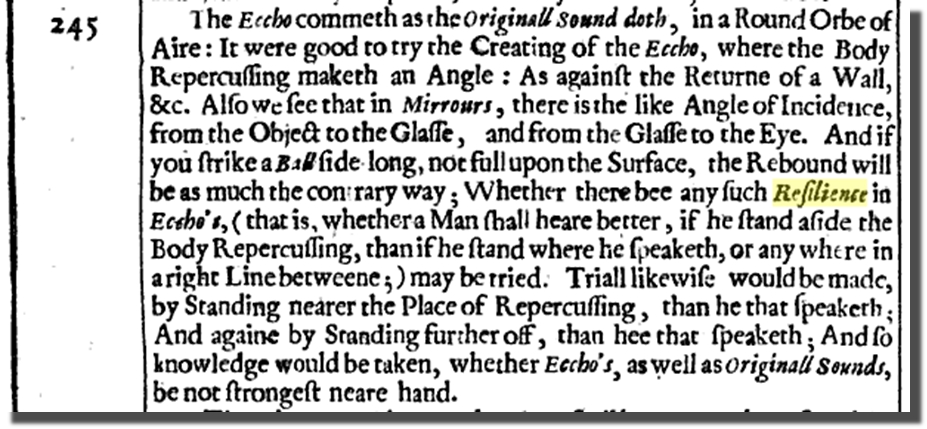
Bacon on Resilience, 1625
To state that the term 'resilience' was invented in a bouncy castle in North London is about as accurate as writing that Richard III died after being knifed in the buttocks in a car park in Leicester. However, there is more to the story than mere embroidery of the facts.

Canonbury Tower was constructed in the early 16th century on the site of Roman remains. The builder was William Bolton, Prior of St Bartholomew, the forerunner of the eponymous hospital. In 1537, when Henry VIII dissolved the monasteries, the tower passed to Thomas Cromwell, First Earl of Essex (1485-1540). As State property, for the period 1616-26 it became the residence of Sir Francis Bacon, Lord Chancellor of England (Glinert 2012, p. 359). Bacon is credited with devising the modern scientific method, or at least the inductive version of it. He was also responsible for the first known use of the term 'resilience'.

Many students of the robustness of things, systems and people believe that 'resilience' was coined by C.S. Holling in his landmark 1967 paper on systems ecology (Holling, 1967). For example, Berkes (2007, p. 286) wrote, "Originally developed as an ecological concept, resilience is being applied to coupled human-environment systems." Goldstein and Brooks (2006, p. 3) were a little more generous with time when they stated that "The study of resilience traces its roots back a scant 50 years." In reality, the word has a very much longer history (OED 2013). It stems from resilire, resilio, Latin for 'bounce'—hence the idea of 'bouncing back'.

The etymology of resilire is unknown, which indicates that it was probably a part of standard Latin—as much as any such thing existed—in Classical times. The term appears in the writings of Seneca, Pliny the Younger, Ovid and Livy. Much later, it passed into Middle French (resiler) and then across the Channel into English as the verb resile, a word that appears in the State Papers of King Henry VIII in 1529 and evidently relates to his troubles with his first queen, Catherine of Aragon (1485-1536). Here, it was used in the sense of 'retract', or 'return to a former position'.

In the late sixteenth century, the term seemed to have enjoyed greater use by the Scottish intelligentsia than by its English counterpart, and it was intimately interwoven into the Scots dialect. Although resile faded from use in the 1700s, since then it has been periodically revived in writings by those authors who like to employ anachronisms.

Bacon was unusual for his time in that he wrote in both Latin and in English, the latter for a greater divulgation of his work. Hence, there was bound to be some transfer of terminology between the two languages. In 1625 he published a compendium of writings on natural history, the Sylva Sylvarum. In this, during a musing on the strength of echoes, he used the term resilience (Bacon 1625, p. 245—see figure, above).

The first known dictionary definition of resilience comes from the Glossographia compiled by the lawyer and antiquarian Thomas Blount (1618-79). It is interesting that Blount chose the word resilience to be among the 11,000 that he felt were far enough from common parlance to merit defining. He attributed it a dual meaning: to rebound and to go back on one's word (as in resilement, an obsolete derivative). Blount's lexicon went through several editions and was imitated by eighteenth century authors (whose works also included the term resilience), but the Glossographia faded into obscurity with the publication of more authoritative compendia.

It is interesting to note that the appearance of the word 'resiliency' post-dates 'resilience' by several years. Apparently, the former was first employed in 1651 in the English translation of Lumen divinum reformatae synopsis ("Natural Philosophy Reformed by Divine Light"), which was written by the Moravian theologian John Amos Comenius (1592-1670). This work was originally published (in Latin) in Leipzig in 1633 as part of Comenius's Didactica magna omnibus. At the time, Comenius was busy making Swedish schools resilient.

In the first half of the nineteenth century, resilience was still used in the sense of rebounding. Samuel Taylor Coleridge employed it thus in Hymn to Earth in Friendship's Offering, a rather mediocre poetic offering dated 1834:-

Inly thou strovest to flee, and didst seek thyself at thy center!
Mightier far was the joy of thy sudden resilience: and forthwith
Myriad myriads of lives teemed forth from the mighty embracement.
Thousand-fold tribes of dwellers, impelled by thousand-fold instincts, [...]

At this time the two nouns, and the verb, were used in various ways to denote rebounding, elasticity and fickleness. The last of these is, of course, a negative connotation, and one that was employed from Samuel Johnson in 1751 to Henry Best in 1826). Portentiously, from 1839 the term was also used to signify the ability to recover from adversity.

The first serious use of the term resilience in mechanics occurred around 1858, when the eminent Scottish engineer William J.M. Rankine (1820-72) employed it to describe the strength and ductility of steel beams. In an applied context, it was used in 1867 to describe the robustness of the cladding of the prototype iron ships. Herein lies the origin of the modern use of the term in civil protection. A resilient steel beam survives the application of a force by resisting it with strength (rigidity) and absorbing it with deformation (ductility). By analogy, the strength of a human society under stress is its ability to devise means of resisting disaster and maintaining its integrity (coherence), while the ductility lies in its ability to adapt to circumstances produced by the calamity (Alexander 2012).

Resilience and resiliency are synonyms. They have been widely applied in mechanics, particularly to the resistance properties of steel, yarn and woven fabrics (Hoffmann 1948). The adoption of the concept by Holling was specifically related to a systems theory approach to analysis of the stability of ecological assemblages (Von Bertalanffy 1950). This derivation does not work well when it is transposed to situations in which the general systems characteristics are less formally defined.

In the 1950s, the term resilience started to be used in psychology and it finally became popular in this field in the late 1980s (Flach 1988). It has been used particularly in relation to the psychiatric problems of children (Goldstein and Brooks 2006).

Independently of developments in psychology,  at the end of the 1990s resilience made the transition from natural ecology to human ecology (i.e. social sciences) thanks to the work of economists (e.g. Batabyal 1998) and geographers (e.g. Adger 2000). One legacy of ecology is an enduring emphasis on system stability as a hallmark of resilience. Perhaps questioning that ought to be a goal of future theoretical work.

Lastly, if 'resilience' was indeed first coined in Bacon's study in Canonbury Tower, there could not have been a more appropriate place for that to happen. Apparently, Bolton had the tower built because he was much troubled by the predictions of astrologers that there would be a return of the Universal Deluge. Hence, he had it stocked with two month's supply of food—very resilient!

References

Adger, W. N. 2000. Social and ecological resilience; are they related? Progress in Human Geography 24(3): 347-364.

Alexander, D.E. 2012. Resilience against earthquakes: some practical suggestions for planners and managers.  Journal of Seismology and Earthquake Engineering 13(2): 109-115.

Bacon, Francis 1625. Sylva Sylvarum, or of Natural History in ten Centuries. W. Lee, London.

Batabyal, A.A. 1998. The concept of resilience: retrospect and prospect. Environment and Development Economics 3(2): 235-239.

Berkes, F. 2007. Understanding uncertainty and reducing vulnerability: lessons from resilience thinking. Natural Hazards 41(2): 283-295.

Blount, T. 1656. Glossographia; or, a dictionary interpreting the hard words of whatsoever language, now used in our refined English tongue. The Newcomb, London.

Comenius, John Amos 1651. Natural Philosophy Reformed by Divine Light: Or lumen divinuem reformatate synopsis (Leipzig, 1633), London 1651.

Flach, F.F. 1988. Resilience: Discovering a New Strength in Times of Stress. Fawcett Books, New York, 264 pp.

Glinert, E. 2012. The London Compendium. Penguin, Harmondsworth, England, 523 pp.

Goldstein, S. and R.B. Brooks 2006. Handbook of Resilience in Children. Springer, New York, 416 pp.

Hoffman, R.M. 1948. A generalised concept of resilience. Textile Research Journal 18(3): 141-148.

Holling, C.S 1973. Resilience and stability of ecological systems. Annual Reviews of Ecological Systems 4: 1-23.

OED 2013. Oxford English Dictionary on line: www.oed.com (accessed 6 February 2013).

Von Bertalanffy, K.L. 1950. The theory of open systems in physics and biology. Science 111: 23-29.

Wednesday, 30 January 2013

The tragic absurdity of nightclub fires


On 20 February 2003 fire broke out at The Station Nightclub in West Warwick, Rhode Island, USA. One hundred people died in the crowded locale, 230 were injured and 132 escaped unscathed. The salient characteristics of this event were as follows:-

  • pyrotechnics were used as part of the act that patrons were watching
  • the fireworks set light to highly flammable sound insulation
  • the fire propagated extremely quickly (30 cm/sec) and produced large amounts of toxic black smoke
  • the nightclub was crowded about 50 per cent beyond its legal capacity
  • many patrons did not know where the emergency exits were and hence a crush and blockage rapidly developed at the main entrance, which was too small for the number of people who attempted to pass through it.
The disaster was filmed in its entirety (which led to the prosecution of the film company for $30 million for allegedly obstructing the exits) and the propagation of the fire was modelled digitally in fine detail.

The West Warwick tragedy was neither the first nor the last nightclub fire with the characteristics listed above. On 30 December 2004, 194 people died in the República Cromañón Nightclub fire in Buenos Aires, and on 1 January 2009 66 people died in a very similar incident, the Santika Nightclub fire in South Korea.

The Kiss Nightclub fire in Brazil occurred on 27 January 2013 in Santa Maria, Rio Grande do Sur state, Brazil. It killed 230 people and injured 120, 70 of them critically. This event had all the characteristics of previous nightclub fires involving indoor fireworks, highly flammable construction materials, overcrowding, poor management of exits, and thus appallingly high risks and lack of safety for patrons and workers at the locale. Indeed, it is reported that door managers initially tried to prevent people from leaving, as they could not guarantee that bar bills had been paid. It is common in these instances to find lack of emergency training and missing or defective equipment (it is reported that an extinguisher employed to put out the initial fire did not work).

It is particularly striking that at irregular but frequent intervals in different metropolitan areas around the world the same disaster occurs. Everything about it is preventable. Cladding and construction materials should not be highly flammable; electrical systems should be in good condition; there should be adequate fire suppression systems; exits should be adequate, functional and well signed; overcrowding should be avoided; pyrotechnic devices should not be used indoors; and staff should be trained in how rapidly to recognise an emergency situation and manage it to best advantage. Finally, as nightclub owners evidently cannot be relied upon to do these things, local authority and Fire Service enforcement should be sufficient to compel them.

One hopes that Brazil will improve its ability to manage such risks by the time of the 2014 World Cup Football and 2016 Olympic Games.

Reader: if you frequent nightclubs or any similar locales and find emergency exits chained up, or any other evident safety violations, call the police immediately and do not cease to protest until the situation has been resolved.